Cloud computing is rapidly becoming a significant part of the business world. Especially now, since most of the corporates are figuring out ways to adopt remote working as their permanent arrangement of work.
However, there are still plenty of challenges that many are facing in terms of understanding the tool’s true implementation. On the other hand, others may only have limited experience working with the tool.
Thus, there is a dire need for online training for remote teams. This training will ensure that your organizational goals are being achieved as your employees perform their best without facing any issues in regards to the virtual office.
To make sure that your employees are motivated enough to get involved in online training, it is best to take help from LMS consultants. These consultants will help you map out the process and choose the best learning management system for your organization. The one that aligns well with the features you require.
A learning management system or an LMS is a cloud-based tool that not only makes training employees virtually easy but also makes it a lot more interesting at the same time. It is this tool that allows you to create, deploy as well as monitor the performance of your remote employees.
Because of an LMS, employees can now access the material from wherever they wish, be it in a different location or a different device. Moreover, they can also save money on traveling or various registration fees.
There are also several other benefits that come with a cloud-based platform and you can read about them all below.
Get certifications easily
One of the many benefits that online cloud training brings is that of achieveing the certification that will actually hold value from the comfort of homes. When employees attend an in-person training session, the chances of the course causing inconvenience in terms of traveling, cost, etc are plenty.
With an online course, it becomes much easier to train remote employees in cloud computing. This further helps in increasing the skill set of employees and add to their growth.
There are also plenty of online courses that can lead the path for many to get certified from the leading cloud providers like Amazon or Microsoft.
Learn from an expert
Taking your education from an expert can do wonders. It makes a huge difference in the quality that training sessions will offer to your employees when they are being taught by the leading names in the industry.
When you host an online cloud training, it becomes easier for you to connect your workforce with the industry leaders. When your cloud novices are learning from the cloud pros, it will truly be beneficial for you as an organization and for employees as well.
Employees will feel motivated to e-connect with their idols and grow, which will in turn reflect in their performance.
Immediate use of skill
Quite often when you take the traditional in-person training, the chances of you getting an opportunity to make use of the skill are pretty low. There are a plethora of features that cloud courses are equipped with such as labs and practice tests. These tests help you to further test your skills and understand how much knowledge you could actually gain.
With online classes, you can almost immediately step into the digital cloud environment to use the new skill that you have added to your kitty. When you are online, it becomes extremely easy to switch from the practice environment to the real-world one.
Conclusion
Cloud computing is one of the major parts of companies now, especially the ones that are remote. Thus, training your employees in cloud computing is a need now. With remote teams, what’s better than online courses?
Over the past few years, real estate agents, investors, and property developers have been using video to make connections with potential buyers and spread the word about real estate investments.
Real estate companies recognise the importance of video and how valuable it can be to their marketing campaigns. This type of marketing gives a true depiction of what you are trying to convey, such as the size and condition of a property.
Video marketing can be used to promote residential and commercial real estate. Evidence shows that potential buyers are most likely to start their search online when it comes to investing, and sellers too, prefer to list their homes with companies who offer video services.
Let us delve into why video marketing has become such an integral part of some real estate companies’ strategies.
Many agents believe it gives them the opportunity to explain things more clearly to prospects and clients. Video can connect a viewer to the property without them having to visit the site, and they can still get a real feel to how spacious a property is. It allows agents to book more meetings and send video messages which typically have a better response rate than a standard text email. Video marketing not only helps to drive deals forward by cementing a personal connection, but it saves time too. Videos can be repurposed and shared time and time again.
Video marketing works for all types of people involved in real estate from sales agents attracting leads and showing properties in the best possible way, to developers and investors who are looking to speed up the process of future investments. Below are some of the ways how real estate companies are using video marketing to get ahead of the competition and entice more people to buy or sell a property.
Social Media
Using video in advertising campaigns can be a great way to reach potential investors, especially when promoting through companies’ social media. Platforms such as Facebook, YouTube, and LinkedIn open up opportunities for those wanting to turn prospects into leads, and campaigns that contain videos often do better than those that don’t. By posting real estate videos on social media, it gives businesses brand exposure and provides viewers with insightful content into what the company can offer. Social algorithms heavily prioritize the use of video to increase engagement, so it’s no wonder real estate companies are joining the hype.
Video Tours
Another way companies are incorporating video is through the use of real estate video tours. By offering different media to your sales pitch or real estate listing, it amplifies the businesses’ strategy. It gives investors a feel for the type of service they offer – working hard to connect buyers to future investments. Companies can record personal tours for clients and repurpose recordings to target new prospects further down the line, saving time and money whilst increasing the number of leads. Video tours can be created using a high-quality camera on a smartphone or by employing a videographer to help communicate and connect real estate companies to sellers and buyers.
Drone Footage
Aerial shots are highly sought after when it comes to real estate, and the cost of hiring a drone photographer isn’t as expensive as it once was. This may be why more real estate companies are choosing to use this footage when showcasing properties and land on which they sit. People are always looking for ways to stand out from other companies and get ahead of their competitors, and drone footage allows them to do just that. Realtors recognize the importance to inspect the surrounding area of a future asset, as location and local amenities play a crucial role in the value of a property. For further tips about choosing the right real estate investment, look to online guides by industry experts like RWinvest.
Educational Videos
The types of videos that real estate companies choose to promote on their social media platforms and via email need to be informative to add value to potential buyers. Companies are using educational videos to guide first-time buyers through the process. This allows for transparency when it comes to knowing how much real estate they can afford, which rates are best for them, and what financial benefits they can expect to receive. Videos such as these not only offer peace of mind to those looking to secure a deal but can provide experienced investors with valuable insight into where the best places are to invest and how they can expand their investment portfolio.
Contract Walkthrough Videos
Videos are not only useful to buyers and investors but can be hugely beneficial to real estate salespeople too. Contract walkthrough videos have been extremely popular during the past few months when it comes to closing deals. It can be challenging to talk prospects through contracts and answer any concerns when you are unable to meet face to face. Salespeople can record a video talking through the contract and elaborating on essential clauses. This will avoid any misconceptions in the future, keeping all parties happy and allowing for a swift and easy process.
Hopefully, this guide has provided you with some understanding into some of the ways property companies are using video as part of their business strategies, and how it can be helpful to both investors, and other companies, looking to implement this useful tool too.
If you are planning to launch an online business, then it is likely you have already looked at options for building and hosting your website, including the popular site builder and hosting platform WordPress. WordPress has long been an industry leader for both personal websites and online businesses, and for good reason: WordPress boasts an impressive selection of themes, add-ons, and customization options for a user so that you can build the exact site that you envision.
However, building a site with WordPress goes a lot deeper than just dropping content blocks into place and building an attractive page for visitors to interact with – you will need to consider a range of things including your inbound marketing strategies, user experience, your mood and tone on your site, and much more.
A strong business website is many things all at once, just as a successful business is many things to many different types of customers. The following are just some of the key points that you will need to keep in mind as you focus your efforts and continue to expand your business to reach the customers who will benefit most from your expertise, products, and services. You can also go through this article to see how to form an LLC in Wyoming.
Tips For Your Web Design and Strategy
The following are a few of the most important tips for both your web design and marketing strategies, but this list is nowhere near exhaustive.
Your Website Is Your First Impression
Think of the first page that a visitor enters your site into as a waiting room in a brick and mortar business. Would you want to work with a business that has a messy, dirty, or uncomfortable waiting room or office? How about shopping in a store where there are lights out, products scattered across the floor, shelves a mess, and inattentive staff ignoring you? When someone clicks into a website, they will notice and internalize all of the issues with your site at a very high speed and will decide to either move forward or “bounce” back to the search engine results pages in less than 15 seconds.
If you drive to a business, park your car, walk to the front, and then start to feel uncomfortable about the way that the business presents themselves, you have already put a lot more effort into the entire process than if you simply searched for a term, clicked a result, and entered a website. For this reason, it is just as easy to go back to the results page and look for the next business offering a similar product or service (and remember, there are many).
Focus on keeping a clean, intuitive, and easily navigable site that users find welcoming and simple to find what they need. Your users will thank you, and the search engine crawlers will reward clean navigation by improving your ranking on the search engine results pages.
Never Bait and Switch
If you are selling a product or service, then upselling a customer is always a bonus for you, but it should always be a benefit for them, too. If people are upsold on a product or service only to realize that you sold them on more than they needed, or that the product or service is not as good as you claimed, then this will hurt your online reputation just as much as your “IRL” reputation – and perhaps more. Sites like Yelp help users learn about the quality of brick and mortar stores, but the stores will always be in a fixed location and will have the opportunity to get clients and customers just off the street. Your website will not have that luxury.
If users start to have bad experiences with your site and submit reviews to Google, Bing, and other search engines, your rankings on the search engine results pages will suffer significantly. Remember that Bing and Google want to provide their users with the best experience possible, and if sending them to your site will result in less-than-ideal business interactions, then they will want to send fewer and fewer to you. It can be very difficult to climb back out of a traffic issue stemmed from bad reviews, so running your company in a respectable and transparent manner is key.
Content is King
Web users want useful, valuable, and engaging information when they visit a website. You are the expert in your field, and your visitors want to benefit from your expertise so that they can learn about the information that you have to provide. When a user visits your site and recognizes that you are an authority in your field who is willing to share your knowledge with them, they will trust that your business is one that they want to transact with. If, on the other hand, you provide confusing information with bad grammar and sloppy formatting, this will send up red flags that are hard to look past when working with an online business.
When you begin researching marketing channels for your online business, you will certainly come across the term “SEO” often, though it may be difficult to figure out how to actually implement an SEO strategy that moves the needle. WordPress offers a number of highly useful SEO tools, but the most important thing to remember about using SEO is that you need a long-term content strategy – a few blog posts here and there won’t cut it. Quality content released at a steady clip is the best way to rise to the top of the search engine results pages and keep your users coming back for more.
While looking for an SEO strategist to help you get on the right track, make sure that they are well-reviewed and reputable. There are many black hat SEO strategies that can result in quick boosts of traffic that will ultimately result in penalties and tanked rankings – well after the SEO strategist has disappeared into the ether with your money. Good SEO doesn’t just trick search engines into directing traffic to your site – good SEO provides your visitors with highly useful information and engaging content.
Focus on Responsive Design
With more than half of all web traffic coming from mobile users now, it is important that you design a site that incorporates responsive design so that your mobile and desktop browsers can both have a simple and attractive experience while on your site. Fortunately, WordPress makes it easy to build a responsive site, with most themes available having an automatic responsive design that will generate a beautiful mobile site alongside the desktop version that you focus most of your design efforts on.
Without responsive design, you are leaving over 50% of your users out in the cold, and your conversions will suffer as a result. Make sure that when you are selecting from one of the many high-quality WordPress themes in the early phase of your build that you have one that provides you with responsive design, otherwise you will realize your costly mistake once your traffic is suffering. Mobile use is significant and still growing, so don’t miss out on such a big piece of the pie.
Leverage Your Social Media
Social media is a highly effective tool to leverage existing traffic and reach new audiences with your content – all for free. When you create engaging content on your website and share that through your existing social media channels, you will be able to remind your followers that you are around, relevant, and continuously sharing new and useful content. In addition, you can encourage them to share with their own friends’ lists which will even further amplify your message and reach new users.
Make sure that you have social media share buttons on all of your content so that if a reader finds something particularly useful or interesting they can share it with one click of their mouse. Something to keep in mind is that social media posts with images are 200% more likely to be engaged with than articles without images. When someone goes to share your content on Facebook, remember that there is automatically an image that populates on the post, so make sure that the header image you select is eye-catching for when it gets shared.
However, make sure that you don’t exclusively rely on your social media for traffic. There are some businesses who have done very well with this strategy, but it is important that you take a diverse approach when first starting out to make sure that you explore all options. If, in the long run, you find that your social media channels are the best tools for meaningful traffic, then you can adjust accordingly.
Understand and Focus on Target Audiences
It can be tempting to try to cover all bases and hit all audiences, but this is an easy way to overwhelm yourself with trying to please everyone when in reality you should be focusing on some specific years and target audiences. For example, if you are a butcher then there is no reason that you should be targeting vegetarian users, just as a truck manufacturer might not want to spend too much of their marketing efforts on reaching people who live in city centers. You know your business, and you know their needs, so it will greatly benefit you to think of them in terms of a few “personas” and focus your user experience design on these specific personas.
Once you have established your target audiences and personas, you will be able to reference these hypothetical users while you are building your user journeys on your site and trying to determine the most appropriate conversions and calls to action for a visitor. Each bit of copy that you write for your site and each piece of content that you create can be written towards one, or multiple, personas so that you can ask “how will X users interact with this article?”
Without clear target audiences, a company will have a confusing, scattered, and inconsistent strategy that can result in missing the mark with everyone instead of hitting home with a limited audience. Once you have truly locked your web strategy in with your starter personas, you can branch out from there, but do not try to please everyone all at once – it never works.
Get Help From Professionals
Professionals at work
You are a professional who knows your industry inside and out, and that’s why people turn to you when they need help in your industry. However, it can be easy to overlook the fact that professional help is valuable when it comes to building a website, especially when platforms like WordPress and Squarespace provide such a simple pathway towards having your site launched. The reality is this: WordPress development is a complicated process that a novice can easily get overwhelmed or misdirected with.
Part of the allure of WordPress is the ready-made plugins that you can choose from to help enhance your site experience; however, each of these plugins runs the risk of slowing down your site, cluttering your homepage, and otherwise dissuading a new visitor from sticking around and getting to know your brand or business better. When you are working with a professional, they can sit with you in the early planning phases and help you stay on track – installing tools and features that your target audience find useful without bogging down your site, impacting your load times, and cluttering your site.
Foster an Active Online Network
Part of a successful SEO strategy is called “backlinking,” and it requires having other reputable websites provide links to your site in their own content. The Google and Bing crawlers index websites in a multitude of ways, including recognizing the amount of inbound (as well as outbound) traffic that the site is involved in. The more reputable sites that have links pointing back to your website, the more the crawlers assume that your website is accepted by other industry leaders as a trustworthy source for information, products, and services.
Part of your backlink strategy will require fostering relationships with these other online businesses in your industry, so you will want to make sure that you are communicative and supportive of the overall community. Remember the saying “a rising tide lifts all boats” when it comes to your online network, where other sites will be happy to either let you write guest posts on their sites or point their own users to your page as another authority to help them gather all of the information that they need.
The internet is a marvelous invention, but just as any great thing in life, it can often be a double-edged sword. You have access to any kind of information in mere seconds, but your online activity can also leave you prone to malware attacks, which can steal your data and invade your privacy.
To put it simply, malware is a type of software that grants unauthorized individuals access to devices or networks with the purpose of sabotage, theft, or espionage. Viruses are one of the most common types of malware, but hackers have plenty of tools they can use to achieve their goals.
Continue reading to find out more about the most common types of malware and how to detect them.
Ransomware attacks use software that encrypts the target’s data, blocking access to it until a specific decryption key is provided. Some hackers block the entire system, while others only encrypt certain important files, but the result is always the same: the attacker will demand payment in order to provide a decryption key.
One example is RobbinHood, a type of ransomware attack that hit Baltimore government’s computer systems. The attackers demanded 13 bitcoins to give back access to the systems, but the attack ended up costing the city over $18 million because it was forced to suspend activities such as tax collection, government email, and property transfers.
Adware
Adware is a less harmful type of malware in the sense that it does not install malicious software or code on a user’s device and does not log keystrokes. Still, what adware does is it tracks your online browsing activity to recommend ads that serve the attackers or their clients.
The biggest issue with adware is the invasion of privacy, as their online activity is monitored and valuable private information is captured. Although they are a must, strong passwords don’t work against malware, so consider installing a good antivirus to add an extra layer of protection.
Trojans
Similar to the Trojan Horse that helped the Greeks win the war with Troy, a trojan virus is a code or software that is disguised to look desirable, but in fact, hides malware. Once downloaded, Trojan viruses can gain control over a system and make changes for malicious reasons.
Trojans have been around for a very long time, but they were never as dangerous as they are today. They are usually hidden inside seemingly legitimate apps or programs, such as games, upgrade patches, or email attachments. Then, once the victim executes the file, the Trojan can start doing its work.
Viruses
People often think that malware and viruses are one and the same, but vin fact, viruses are just a type of malware, and they are very different from Trojans or worms, for example. A virus is, in simple terms, a piece of code that infects an app or program and executes when the user runs that specific program. Once it penetrates a system, the virus can be used to steal data or launch cyberattacks.
To differentiate viruses and trojans, you need to look at the method it executes and reproduces. Compared to a Trojan, which requires the user to only access the file once for it to execute and spread, viruses can only do their job when the app they infected is running, which is why it needs to spread very fast and reach as many apps as it can, in order to be effective.
Worms
Worms are a type of malware that exploits network vulnerabilities and spreads through them. They can gain access through backdoors built in various files or, as you often see in movies, through flash drives. Once they enter the victim’s computer, they can be used to steal data and conduct ransomware attacks.
Worms don’t need the user to run a specific program or keep certain applications open, as they are self-replicating standalone software. One of the most notorious worms was the infamous ILOVEYOU worm, which made countless victims at the beginning of the 2000s.
Rootkits
This is a type of malware that gives a hacker complete remote access to the victim’s computer. They can be integrated into apps, firmware, or kernels, and they often spread through malicious attachments and compromised files.
Rootkits can often be used to conceal other types of malware, such as keyloggers, and have made many victims over the years. One example is Zacinlo, which is a type of rootkit that acts as an advertising click fraud. Once it gets into a person’s computer, the program checks and uninstalls any malware that may compete with it, then opens browsers that the victim does not see and starts interacting with them. The main purpose of this rootkit is to click on ads in these invisible browsers and hackers get a cut of the commission.
A website is a reflection of your business and to improve user experience you must take some necessary steps. It’s the first place a customer encounters your business online. A website is also excellent for revenue boosts. It’s a powerful tool that forms the basis of digital marketing campaigns.
To make your website responsive, you must focus on customers’ needs. It helps if you add value by improving the user experience on your site. Improving user experience would mean that:
You attract a visitor to your website
The visitor responds by going to your site
The visitor scans your website and finds what they are looking for
They respond by interacting with your products and services
But to get a positive response, your website must influence their choices by reducing obstacles. Your website must also make it easy for visitors to accomplish their goals.
If you are thinking of improving the user experience on your site, here is a check-list you should keep in mind:
Credibility – How many people can recommend your brand?
Usability – How easy is it for visitors to use your CTAs?
Value – What result can visitors expect from your site?
Accessibility – Can people with disabilities navigate your site?
Navigation – How easy is it for visitors to move from page to page?
Satisfaction – How does a visitor feel after leaving your page?
Emotional drives – Does your website build and nurture relationships?
In this article, we will take a closer look at ways you can tweak your website to improve user experience.
How to Improve User Experience on Your Website
1. Make Every Page Scannable
It’s a fact that most website visitors are scanners. In other words, they will pick bits of text on your website and only consume what they find appropriate. At times, they will only check the headings and bullet points and leave the page. If your content is packed with too much information in long paragraphs, it’s likely they will miss the most important parts.
The scannability of your pages determines the bounce rate of your website. If you want people to read most of your content, you must present it in simpler forms. Here’s how you can do it;
Subheadings – You should include subheadings that tell the visitor what your website offers. Captivating subheadings trigger your audience to read your content word for word. If you hook a reader on a subheading, you will motivate them to continue reading other parts of your website.
White spaces – If you want to make your website appealing, include white spaces. White spaces break blocks of text to help visitors focus better. They organize your pages so it’s attractive and scannable.
Bullet points – An example is what we are using now. Bullet points are excellent for breaking long texts. You can also use bullet points to highlight key points or present a series of information.
Single-point Paragraphs – They are great for limiting a single idea to one paragraph. This is especially important for readers that focus on take away points.
Highlights – They draw the attention of the reader. If you underline and color your key facts differently, you show readers where they should concentrate. Just remember not to over-highlight your content, or it will lose its meaning.
Images – Visuals draw attention. Using relevant visuals breaks the monotony of continuous texts. You can also include infographics and videos to help discuss complex topics.
2. Include a Prominent Call-to-Action
A prominent call to action will help your audience find their way across your website. It’s through a call to action that a customer can determine their next step on your site. If you want a visitor to subscribe to your email list, it’s essential to include a button or form that encourages them to do so.
When creating a call to action, think of colors that pop. You should also consider terms that create an emotional connection. In most cases, the terms may be what other businesses use on their website. But if the call to action holds relevance to your business, it’s best to include it.
If you are stuck on ideas for a call to action, here are some you could use:
Sign-up – For products and services
Get started – For introductions
Subscribe – For updates
Join us – For communities
Learn more – For extra resources
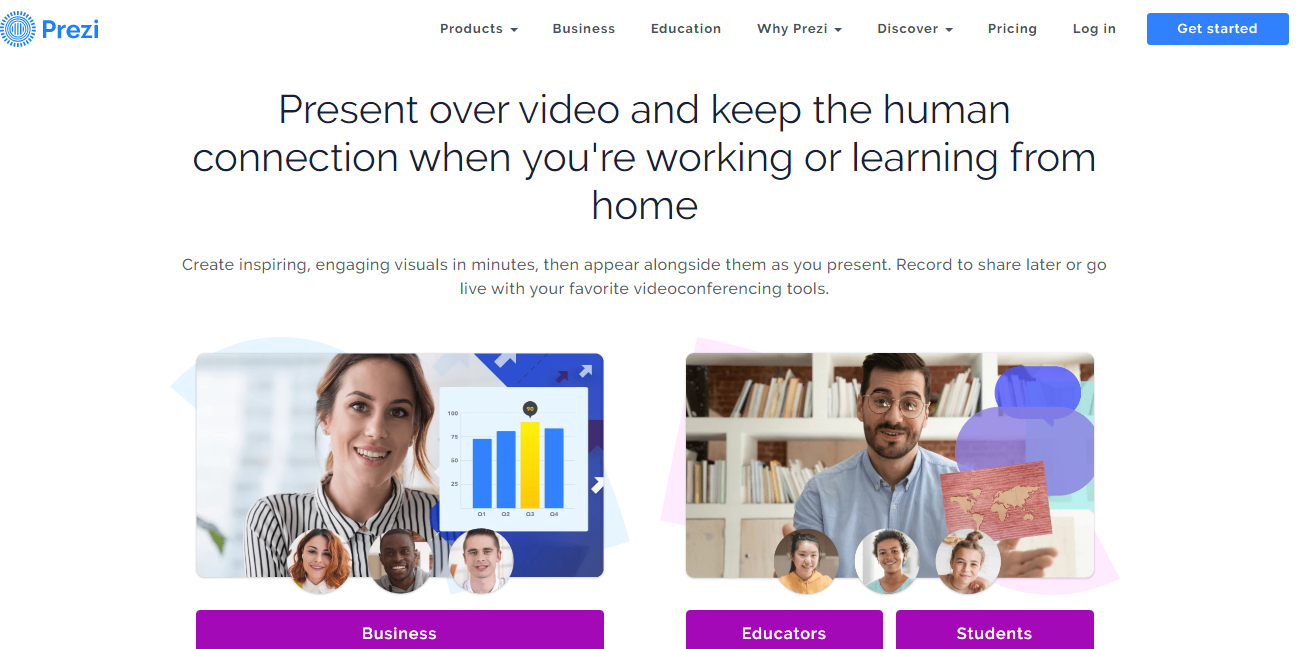
An example of a “Get Started” CTA is this one from Prezi.
You can tweak these CTAs to reflect your brand’s identity. But remember that to ultimately improve your user experience, your CTAs should be placed at every touchpoint on your website.
3. Improve Your Page Speed
How fast or slow your page loads determines your conversion rates. If your pages take too long to load, it’s likely that most visitors will opt out of your websites. Slow speeds are frustrating. They are also a significant cause of high website bounce rates.
Since website visitors exert the least patience, it’s crucial to learn features that can increase page speeds.
First, check your images. It’s important to compress your images before loading them on your website. You can use a software tool like Compressor to reduce the sizes of your CSS, JavaScript, and HTML files.
If you are working with a free website tool, check for poorly coded plugins and external scripts. Poorly coded plugins are a common cause for sluggish pages. You can rectify your codes by reformatting, removing unused codes, and deleting code comments.
Another concern should be inadequate browser caching. To improve on caching, consider using private SEO proxies. Proxies are excellent for caching information so you don’t have to go through the internet for similar requests.
To better understand how proxy caching works, here’s a step-by-step process.
A user places a request on their browser
The proxy server receives the request and checks it’s cached data to see if it has a recent copy
If there’s a similar file, the proxy fetches the information and delivers it to the user.
From the explanation, it’s clear that the request did not go through a search on the internet. It’s also evident that the results were fetched from the proxies’ server.
Proxy caching automatically translates to reduced bandwidths and an eventual improvement in loading speeds on the users’ computers.
4. Use a Responsive and Mobile-Friendly Design
The world has gone mobile. More and more people are finding it convenient to access websites through their mobile phones. It’s now common to find people on commute reading blog posts through a mobile device.
To make your website mobile-friendly, here’s what you can do:
Focus on one topic on each page
Include a drop-down menu that makes it easy to navigate across the website
Make sure that the buttons or tabs are big enough for thump use
Include functionalities that auto-generate the right formats for mobile devices
To confirm if your website is mobile-friendly, try resizing your browser screen. It would help if you also moved through different pages, using the resized screen, to ensure your website is completely accessible from any device.
5. Have a Catchy Headline
A catchy headline has two aspects; It is well-formatted and contains the right keywords. Creating a catchy headline is relevant for attracting the right audience. It also improves your search ranking since it’s most preferred by search engines.
To have catchy headlines, make sure that you understand your audience. Create topics that speak and attract visitors to your site. Also, make sure that your content matches the headline so visitors are compelled to return. Lastly, keep it simple and organized.
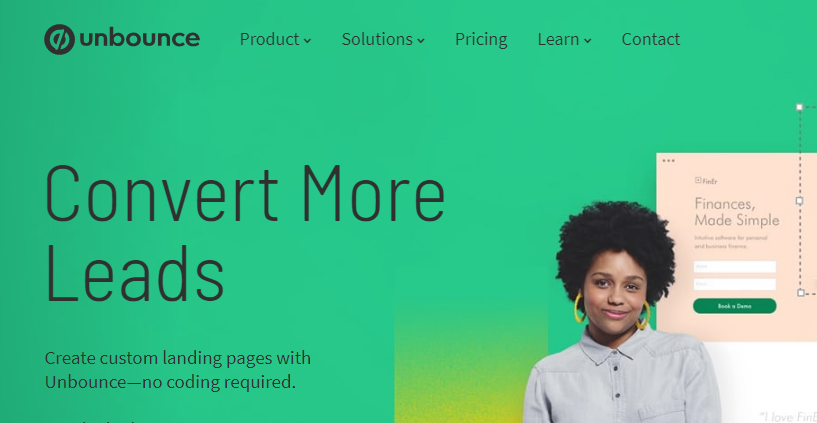
Here’s an example of a catchy headline from Unbounce.
Wrapping it Up
There you have it. The five ways you can improve user experience on your site. While every business is different, these tips form the basis of UX conversations. Remember that improving your website is a constant process. It requires effort and consistency to see everything fall in place.
Hello, my dear friends! Today we will talk about a very interesting topic, about the interview. That article will be useful for JavaScript developers who worry about future interviews. I will write some tips and hope they can help you!
According to Github JavaScript is the most popular programming language in the world as of late 2019. And for good reason:
easy to use;
has familiar syntax;
can be used in a wide variety of programming environments.
But how did this all start? How do we go from JavaScript being a taboo programming language to the most popular programming language in the world? Let’s talk about his history and how it became so.
So first of all, what is JavaScript? JavaScript is the programming language of the web. It was created in 1995 and at the time it was predominantly used to add behavior to websites. Things like making it so that when we click a button something actually happens. This example is something we all take for granted now but it was a huge deal at the time when websites were super simple and predominantly read-only.
JavaScript Explained
In order to understand why JavaScript is so important let’s take a look at how any standard website is built. We have the HTML which is the general structure of the page. We have something called CSS that controls the style of the page or how things look. And finally, we have JavaScript which can dynamically change both the structure and style of the page in response to user actions.
JavaScript is quite a bit more as well. All this rich dynamic behavior that you experience every day is driven by JavaScript.
In the past 10 years or so JavaScript applications started to get really complicated. So the community builds libraries that simplify how developers build these applications. Some examples of these libraries are familiar ones like React, View, Angular, and more. These libraries aren’t mandatory but they sure make your life a whole lot easier. In recent years JavaScript has become insanely popular thanks to engines like Node.js which allow developers to use JavaScript not only to build just websites but to use it for other things such as hosting standalone applications, talking to databases, and talking to other services.
The flexibility of JavaScript both on the front-end and the back-end have been a major contributor to its long-term success. So that’s what JavaScript is and how it came to be now let’s talk fundamentals.
In order to get started with JavaScript, you need to have a grasp on the language’s structure. The most basic building blocks of any programming language are called primitives. In JavaScript, the primitives consist of numbers like 1, 2, 3, 3.5, and 999. Strings as “hello world”. Booleans which are true and false values. List which is a series of things and objects which are supposed to be the containers for combinations of other primitives. Objects also let you create dictionaries of items so that you can quickly look them up later. Think of an object like a phone book. If you know a person’s name, you can look it up and find their associated phone number very quickly.
Outside of primitives, we have the usual control structures such as “if-else” statements which are used for branching logic for and “while loops” which are used to examine multiple objects in a list one at a time and “try-catch” statements which are used to handle unexpected errors during your program’s execution.
All About JavaScript
We use the terms “var”, “let”, and “const” to declare references to instances of primitives or objects. “Var” is outdated and rarely used. “Let” allows you to temporarily assign something that could be changed later. And “const” allows you to permanently assign something that will never change like the constant time.
The other important aspects of JavaScript are functions. Functions allow you to wrap a bunch of behavior into one variable. For instance, when you attempt to pay a bill on your bank’s website, the website may need to do several things such as verify your identify, make sure you have money in your account, and finally perform the transaction. These three sub-steps can be wrapped inside one function called pay bill. These three smaller steps can also be functions that do separate things. You can quickly see how we use functions to create some rich behavior.
JavaScript itself isn’t that complicated but it’s hard to know where to go next and there’s a ton of conflicting information out there.
What must a JavaScript developer know?
Follow the trends. It is extremely important to know what the world is like and to meet its requirements. The same applies to JavaScript. Developers must be constantly in development trends, interested in what is newly invented, and enriched with this knowledge. There are many options where to look for this information and sites, forums, and blogs for developers. Following the trends is another option to add new customers and delay the stray, because the product that was wildly popular will turn more than once.
Ability to work on different platforms and browsers. A skilled developer knows the intricacies of working on many platforms. Know where you need to fix something to make the product look complete on all browsers. So when a new platform for product promotion appears, the developer must study the features of working on it.
Communication skills. Yes, who would have thought, but no developer sits in silence for days on end. The ability to communicate with both the customer and the team is an extremely important trait of a professional.
HTML / CSS. This will not be about superficial knowledge, but about a clear algorithm. HTML and CSS are one of the components of working with JavaScript. The programmer must be able to vary them, change, add something if necessary, and without a high level of understanding of these programs, it will not work.
There are other programs that would be good to know, now they are only gaining popularity (but we have already talked about trends). We are talking about Bootstrap or other frameworks, LESS, SASS.
JQuery. JQuery is an extremely productive library, I have absorbed plugins, extensions, and shortcuts that speed up some features.
Node. js and Express are two frameworks that are the most popular when it comes to using JavaScript at the back-end. Ideally, to know the two of them, but it is better to know one perfectly than two anyway.
What questions the developer must prepare to listen to during the interview?
How many and which programming paradigms play an important role in the work of a JavaScript developer?
Answer: Two, prototype inheritance (also: prototypes, OLOO) and functional programming (also: closing, functions of the first class, lambda).
What can you say about functional programming?
Answer: Functional programming is extremely important for working in JavaScript. It helps with complex mathematical functions to create programs and helps to avoid data changes.
What is the difference between classical inheritance and prototype inheritance?
Answer: In the first type of inheritance, instances pass from classes and create relationships of subclasses. And in the prototype inherited, instances pass from other objects.
What are the benefits of functional programming do you know?
Attention! What I wanted to draw attention to is that in most cases, the interview questions will be about functional programming. So if you want to impress your employer, then study this question a little more.
Answer: functional programming greatly simplifies the development process, the quick finding of the problem and options for its solution, etc.
When should you choose a prototype inheritance?
Answer: When functional programming does not find a solution to the query; when the object consists of more than one source; when inheritance is needed.
The difference between two and one-way data binding?
Answer: Two-way data binding is special in that when any changes are made to the code, they are automatically displayed on the product interface. With one-way data binding, only the model can make changes (it manages everything).
How are asynchronous programming and JavaScript related?
Answer: asynchronous programming means that the engine runs in an event loop. When a blocking operation is needed, the request is started, and the code keeps running without blocking for the result. User interfaces are asynchronous by nature and spend most of their time waiting for user input to interrupt the event loop and trigger event handlers. This plays an important role in JavaScript because it is ideal for working with the user interface.
Conclusion
So, I want to summarize everything written. The main factor that guarantees a successful interview is your qualification and knowledge of JavaScript with other programs. I hope the questions I have covered here will help you prepare for your interview. Do not worry, behave calmly and you will succeed.
Do you often wonder why your company or business still suffers from a revenue slippage even after deciding to request reviews from your customers?
As a business owner, you feel so lost as to why your business is still on the brink of financial ruin even after doing all you can to flourish. You are beginning to wonder if requesting online reviews from customers was the right decision. You are starting to experience major and minor failures by losing customers, and you think that this is all because of the online reviews you are receiving.
Sometimes, the answer lies with examining if these online reviews that ridiculously get out of hand have been managed well by your company. It is always not enough that your business requests online reviews. These reviews must be managed well, as this will have a significant impact on your business reputation. You can free yourself of these business setbacks by knowing these seven benefits of online management review to your business.
Positivity is the key to success in life. Even in business, welcoming positivity, especially positive reviews, is always its goal. There is, however, still a risk that comes with every business allowing product review function for customers on its page or site. This risk pertains to the possibility of customers posting negative reviews, which can either make or break your business.
Considering that negative reviews are inevitable, this does not mean, however, that business owners are prohibited from moderating or regulating their review sites at all. This is because negative reviews are sometimes fake reviews, offensive, defamatory, or even negative reviews that do not come from your real customers.
Fortunately, there are many options and ways to lessen the impact of these negative reviews. These options may include an available direct answer or conversation to the negative reviews that will show you are trying your best to resolve and improve your products. You may also hire professionals or experts such as Weave to help you manage your business’s online reviews and avoid offensive or harmful thoughts from hurting your business.
Saves Time
Busy schedules and work burdens many business owners or entrepreneurs, and this busyness affects the productivity of their company or business. Extreme Busyness can affect one’s cognitive function, which can lead to depression and anxiety. When business owners suffer extreme busyness that can be avoided in so many ways, it can hurt both the business and the business owner.
To avoid the detrimental effects that extreme busyness can cause, online review management can help in so many ways in reducing business owner’s concerns, such as but not limited to gathering reviews and feedback, answering customer’s queries, or sending reminders and appointments. Online review management not only saves time, but it also saves the business and the owner’s health.
Increases Customer’s Trust
Earning and Increasing customer’s trust is one of the essential benefits of online review management. Just as respect is earned, so also is trust, especially in the business realm. Building a customer’s trust does not happen quickly and is earned over time. Before customers buy your products or engage in your services, they need to trust you first.
The customers need to be assured that what your business showed in your advertisement is true and accurate. For, after all, business is not only about profitability. Business is also about relationships, which are primarily what online management review takes care of. By managing the reviews well, including responding to both positive and negative online reviews, you just gained your customer’s trust and even your potential customers’ trust.
Improves Business’s Reputation
The customer’s trust in your business products always starts with reading online reviews before purchasing your business’s products or engaging your business’s services. In this age of the internet, before the online shoppers trust the recommendations of your customers, they do their own research first by reading the online reviews.
There is, however, nothing to worry about as the said online reviews can be managed, not by allowing only good online reviews of your products, which will make everything unbelievable and unrealistic but by also gathering constructive feedback. Online review management has an effective way of dealing with these constructive reviews to strengthen or improve your company’s reputation.
Increases Company’s Revenue
Online Review Management is highly connected to the business’s revenue. Because of proper online review management, customer satisfaction improves, search results for your product increases, and online business presence is amplified. All these effects lead to one favorable conclusion, which is that your business’s revenue has also increased.
Takeaway
Business owners need not hesitate to ask or gather reviews for their products or services and start thinking that online reviews, bad or good, can help their business grow. With online review management, everything is under control without sugarcoating the truth about your business’s products or services. Having known these benefits of online review management, you are more than ready to face the business world!
Many businesses have blogs. They have websites that advertise their services and products, and then they create blogs where they write about their niche. These blogs become a good way for them to drum up business and get potential customers into their sales funnel.
If you’re going to have a business blog, you need to make sure to avoid a few common mistakes. We’ll talk about some of those right now.
Maybe your company sells an app for self-managed HOAs, or perhaps you make and sell patio furniture. Whatever your services or products, you need to be sure that your company blog:
Stays relevant
Doesn’t go off on a tangent
On a personal blog, you have leeway to write about whatever you want. You can compose a blog about whatever is on your mind.
Your company blog needs focus. You have to make sure your customers and potential customers get value from it, and that means only writing about topics within your niche.
You’re playing with fire when you do that. If you take a political stance, you’re probably going to lose some customers.
If you decide that you want to enter into such controversial territory, make sure that all the company’s decision makers agree to do it. You might flirt with bad publicity if you do this, and you could lose sponsorships, sour business relationships, lose sales, etc.
Don’t Criticize Any Employees
Your blog should be a place where you paint your company in a positive light. You might want to utilize it to talk about how useful your products or services are, what you do to help your community, some of your innovations, etc.
You don’t ever want to criticize how the company operates or call out any particular employees you feel aren’t doing a good job. Your blog is not somewhere you try to settle scores.
If your company made a mistake, you can apologize for it on the blog, but you need to do so tactfully. You can say the company made an error as a whole, but talk about it as a monolith.
Don’t try to hold a particular employee or department responsible. You can handle that sort of thing internally, but don’t write about it where the public can see it.
Don’t Speak Ill of Your Industry Competitors
You likely have some industry competitors within your niche. No company exists in a vacuum, and other businesses probably do what you do or something similar to it.
You might battle with these other companies in the marketplace. You compose ad campaigns to try to steal customers from them, and vice versa.
However, while this is fair game, talking badly about them on your blog serves no purpose. You might not agree with some of their business practices, but your blog should be a place for positivity. You don’t need to declare war on another company there.
Don’t Talk About Religion or Other Controversial Topics
Much like politics, you don’t want to use the blog to talk about religion, controversial social issues, etc. If you do, once again, you’re probably going to lose customers.
As a company, you might agree to take certain social stances, but once you do, you’re drawing a line in the sand. You must understand that some entities will not support you if you go this route.
Changing Dont sign in to Do It
Your blog should highlight your business, products, services, your niche, and similar topics. When you get away from that, it can turn off potential clients, sponsors, and other would-be supporters.
Don’t Write About Poorly Researched Topics
If you’re going to talk about your industry, you need to sound authoritative. If you don’t, it sends the wrong signal. If you don’t know about your industry, potential customers might assume that you make your products poorly or your services are not worth the money.
Only write about things you know about and back them up with data, scientific findings, or at least some personal anecdotes. This shows your clients they can trust you. Don’t spread any conspiracy theories or talk about unsubstantiated rumors.
If you’re not sure you have this writing style down, you can always hire a copywriter or freelancer to handle your business’s blog writing. Just be sure to go over every blog before posting it to ensure it fits your company’s values and goals.
Many companies use blogs to help grow their business. If you have a company website, you should certainly consider it. Blogging is doable if you have someone informative and engaged who’s handling the writing chores.
Let’s look at some specific ways blogging can help your company succeed.
You Can Attract Long-Range Business
You need to write blogs about what you know. You can write about an alternative to Bluecat Enterprise DDI, social media marketing, dog grooming techniques, or whatever else strikes your fancy. The point is, your blog:
Should attract interested potential customers
Should feature evergreen content frequently
Evergreen content is not topical. It’s content that’s as useful in five years as it will be today.
Try to come up with blog topics that will keep potential customers coming back in the future, not just reading them today. You want to come up with posts that feature topics you’re confident will remain popular. You want ones that can bring in organic traffic rather than those where individuals discover them via an outbound link on someone else’s site.
Aside from evergreen content creation, you can also go back and update old blog posts with new content. Maybe what you stated about something still applies, but now that some months or years have passed, you can refine or enhance what you said.
You Can Talk About What Your Business Can Do
With business blogging, you’re trying to strike a balance. Your blogs should:
Talk about what your business can do or what you offer
Offer value rather than just being a straightforward sales pitch
When someone starts reading your blog, they want usable information. You need to provide that, but at the same time, you need to tie your company, products, or services into what you’re saying.
This can be challenging. You want to talk about your niche or other scintillating topics, but you want to weave in a sales pitch. You might not be so good at striking this tone at first, but you can get better if you practice.
You can talk about your past successes if you can find a way to make that relevant. You can also add some provocative photos for visual aid.
You Can Create a Need Rather than Address a Pain Point
Customers often shop based on pain points. In other words, they need some service or product to alleviate a need they have.
You can speak about a customer’s pain point in your blog, but you can also talk about the potential customer into wanting something they didn’t when they first started reading. Maybe you make some particular wellness products, food items, clothing items, etc.
Your reader might not start reading your blog thinking they need that specific thing. You have to depict it in such a way that when you finish, you’ve completely convinced them they can’t live without it.
If you have prior sales experience, you should be better at doing this. If you don’t have previous sales experience or you can’t master this persuasive writing style, you might get someone else to handle the company blog. This is important, so you have to get it right.
You Can Educate While Entertaining
Nobody wants to read a dry, academic-sounding blog. You might title your blog something about learning a skill, but just because it’s informative, that doesn’t mean you must make it uninteresting.
This is another writing challenge for you. You need to write an article that teaches your reader how to do something while establishing your company as experts in your niche. At the same time, you should make the writing personable and engaging.
Think about your niche, and try to develop some questions your potential customers might have. If you can’t come up with any ideas, look on a site like Reddit. There are subreddits for virtually every niche or interest.
There, you should find individuals talking about what they want and need from your niche. They will probably post questions or ask them in the comment sections.
You can make a blog topic list based on that. Make sure you include keywords and long-tail keyword phrases in your blogs to attract some of these same Reddit users.
The more you work on your blog, the better you should get at these writing styles. If you can’t seem to manage it, you might hire a freelancer or staff copywriter. If you use your website’s blog correctly, there’s no reason it can’t bring you many new customers.
When looking for advice on SEO strategies there are a high number of generic tutorials online, books, blogs, and articles from SEO experts of varying competence levels. That might be sufficient if there was a one size fits all solution, if the industry that evolves constantly suddenly stood still to make your life easy. Your brand deserves excellence so realize your goal of reaching page 1, position 1 on the search engine results page by hiring a trusted London SEO consultant so that you enjoy an outstanding online presence.
You believe that you can handle SEO in-house. You don’t need to pay someone to tell you how to coordinate your SEO management successfully. You can try learning on the job, certainly. In the same way, you might try to learn a second language. There will be ideas that resonate, parts that baffle, and myriad pitfalls and bad practices to avoid. And of course, you’ll be able to spend all day, every day on SEO for a while.
No? You’re running a business, with an assortment of time and energy demands already consuming precious hours. You do what you’re best at, and consult an SEO expert about efficient, cost-effective SEO campaigns and practices that show a significant return on investment.
A little knowledge can be a dangerous thing
Did you know that there are white hat, grey hat and black hat practices that apply to SEO?
You, as a wannabee expert, or the viewer of a few tutorials, might decide to try a mixture of the three. What’s wrong with that?
Well, white hat meets with Google approval, grey hat means you’re courting their displeasure and black hat techniques reward your efforts in a shattering down marking of your website by Google, they won’t tolerate ”toxicity.”
A book might tell you that backlinks, also known as external links and a link building process, are excellent for sending your website to the pinnacle of page 1 but that advice can be misinterpreted. Simply linking your website with a random range of websites that have no relevance to your business, service, brand or product makes the link pointless, if not harmful to your success.
You need to prove to Google that site A and site B have a connection for the link to strengthen your online presence. You may have five hundred friends on a social media site but link building with them all could be a lot of effort and produce little positive effect if any. You could find that you slip down the rankings because of relevance, integrity, and trust matter. Why waste your time on futile endeavors?
An SEO consultant would advise you that all links are not the same, they have varying value when situated in different places on the webpage, that paid for links are less advantageous compared to editorial links and that the RD (referring domains) scores are important, the more powerful the other website, the more dynamic they’ll be to boost your position.
Keywords don’t have superpowers
You may hear that keywords are the way to gain matches, to convert interest into profits. Yes, and no. Like all SEO tools, they are only to be used correctly. Imagine using the handle end of a screwdriver to bash a nail into a wall. You may achieve the task, but poorly, and you’ll know that a correct tool, the hammer, would have saved you time and energy. Keywords placed everywhere on a website but without purpose are weaker and produce lesser rewards.
The days of uploading a word document filled with nonsensical keywords are over. Google penalizes poor practices, remember? They want their users’ experience to be positive and if your content won’t deliver that because it makes no sense, they won’t put you anywhere near the top of the search results. Your content must have relevance, build trust, and have benefits to the searcher.
Trust the fountains of knowledge
An SEO consultant knows the right lengths of text, the density of keywords, and the number of words needed in titles to keep Google’s algorithms happy. It can take years to recover when you make the search engine suspicious. Not even the best endeavors of the most devoted SEO consultant would be able to quickly erase the bad impression that Google has of your disastrous DIY efforts.